
Views: 0 Author: Site Editor Publish Time: 2026-08-20 Origin: Site


Operating off-highway equipment in high-dust environments accelerates engine wear and drastically reduces primary filter life. Standard air intakes are insufficient for agriculture, mining, and heavy construction applications. OEM engineers must balance maximum particulate separation efficiency against strict limits on intake restriction, spatial constraints, and overall vehicle weight. This guide provides a technical framework for evaluating pre-cleaner technologies, sizing units to engine airflow requirements, and mitigating integration risks during the OEM design phase. We will cover the exact specifications required to protect diesel powerplants from catastrophic dust ingestion while maintaining optimal volumetric efficiency. By addressing these engineering challenges early in the vehicle development cycle, manufacturers can prevent premature engine failure and extend service intervals. Proper specification requires analyzing airflow demand, environmental hazards, and physical mounting limitations to ensure the intake system performs reliably under continuous heavy loads.
Establishing baseline expectations is the first step in intake system design. A quality off-road engine precleaner must remove 70 to 90 percent of airborne debris before it reaches the primary filter. This initial separation stage dictates the entire maintenance schedule of the machine. Without it, the main filter media bears the full brunt of environmental contamination, leading to rapid plugging and engine starvation.
Engineers must view the intake system as a multi-stage filtration plant. The pre-cleaner acts as the primary defense mechanism, handling the bulk mass of incoming contaminants. This allows the secondary paper or synthetic media to focus entirely on fine particulate capture. When designing equipment for mining or forestry, the ambient air contains massive volumes of silica, chaff, and coal dust. A standard intake will clog within hours under these conditions, whereas a properly specified pre-cleaner extends that operational window to hundreds of hours.
Pre-cleaning directly impacts the dust-holding capacity of factory standard filters. Dry air filters rely on paper or synthetic media to trap particles. When exposed to heavy dust without a pre-cleaner, dry filters suffer from rapid face-loading. This causes immediate restriction spikes, forcing the engine to work harder to pull in air. The physical structure of the paper media can even collapse under extreme vacuum if the restriction becomes too high.
Oiled filters use a tacky surface to capture dirt, relying on the oil to encapsulate particulates. A pre-cleaner protects oiled filters from premature saturation. If fine dust overwhelms the oiled media, it loses its filtration surface area entirely, turning the oil into a thick sludge that blocks airflow. By removing the heavy mass of dirt upfront, the pre-cleaner ensures the oiled media only deals with fine dust, maintaining its structural integrity and airflow characteristics over a much longer period.
| Filter Type | Without Pre-Cleaner | With Pre-Cleaner | Primary Failure Mode (Unprotected) |
|---|---|---|---|
| Dry Paper Media | Rapid face-loading, high restriction | Extended life, gradual restriction increase | Media tearing under high vacuum |
| Synthetic Dry Media | Surface blinding from fine dust | Maintains depth-loading capability | Pleat collapse |
| Oiled Cotton/Foam | Quick oil saturation, sludge formation | Maintains tackiness for fine dust | Loss of airflow due to mud-caking |
Clean intake air maintains optimal combustion ratios. Variable-load off-road applications demand sustained horsepower. When dust clogs the intake, airflow drops. The engine runs rich, burning excess fuel and generating higher exhaust temperatures. Protecting the intake path ensures the engine breathes freely. This sustains power output during heavy earthmoving or harvesting operations.
Modern Tier 4 Final and Stage V diesel engines are highly sensitive to intake restriction. Their electronic control modules (ECMs) constantly monitor manifold absolute pressure. If the intake restriction exceeds programmed limits, the ECM will derate the engine to protect it from overheating and excessive emissions. This derating translates directly to lost productivity on the job site. A well-integrated pre-cleaner prevents these restriction spikes, ensuring the machine delivers full rated power throughout its service interval.
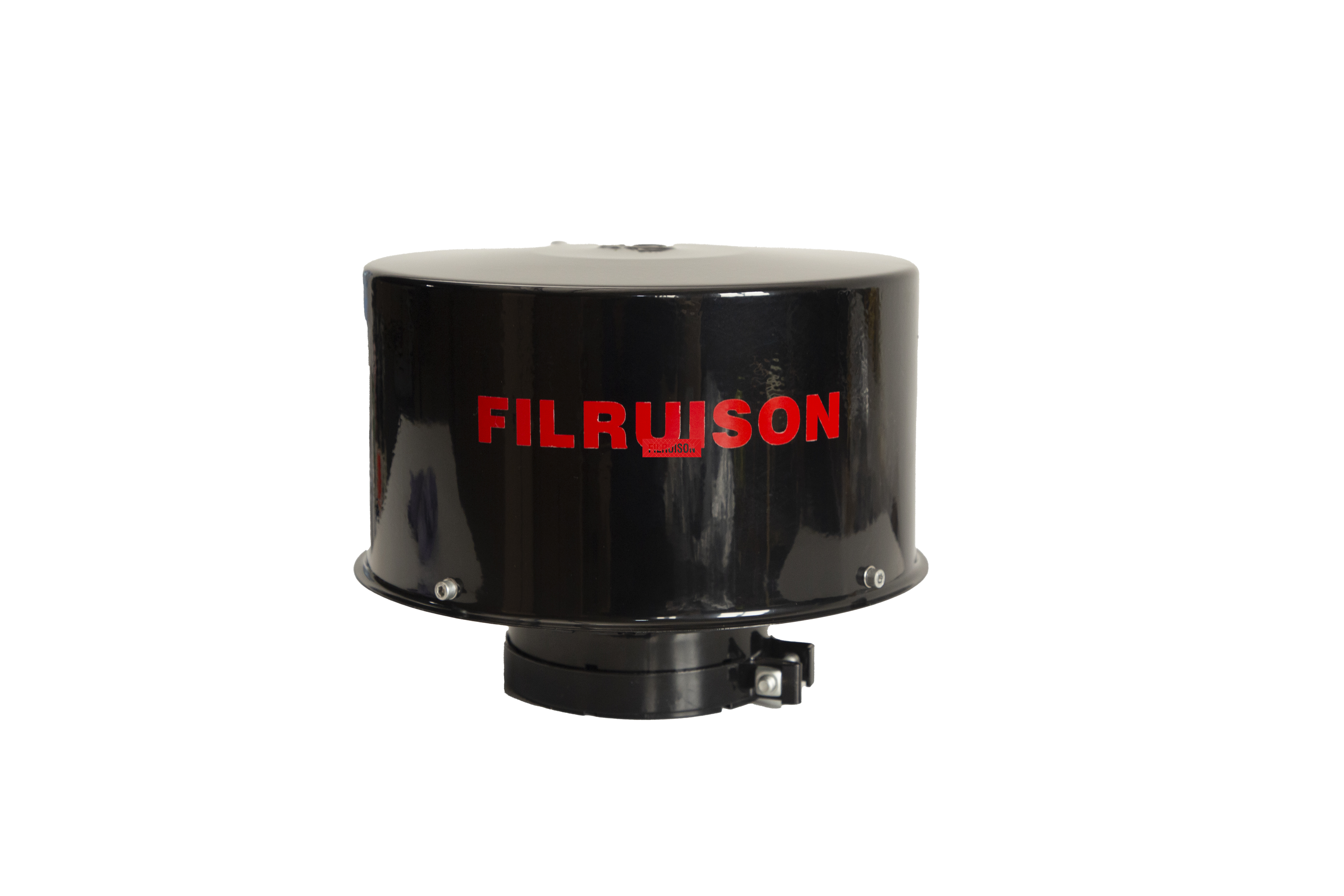
Selecting the right separation technology depends on the operational environment. Different mechanisms handle debris in unique ways, and applying the wrong technology can lead to catastrophic engine failure or excessive maintenance demands.
Static vanes create rotational airflow inside the housing. This centrifugal force ejects heavy particulates outward, separating them from the clean air stream. These units feature low maintenance requirements and no moving parts. They are highly durable in rugged conditions, often constructed from glass-filled nylon or heavy-gauge steel to withstand impacts.
However, their efficiency drops at low RPM or low airflow. The rotational force weakens when the engine pulls less air. Engineers must carefully match the physical size of the cyclonic unit to the engine's normal operating RPM band. If a machine spends significant time idling or operating at low engine speeds, a static cyclonic pre-cleaner may not generate enough velocity to effectively separate fine dust.
Active systems use motorized impellers to generate centrifugal force. They maintain high separation efficiency regardless of engine RPM. This makes them ideal for variable speed equipment or machines that idle frequently in dusty environments. The motorized fan actively pulls air in, spins out the debris, and pushes clean air toward the primary filter.
Engineers must evaluate the electrical draw and integration complexity. Wiring harnesses, relays, and fused circuits add to the assembly time on the factory floor. The electric motor also introduces a potential failure point that does not exist in static systems. Active systems are typically reserved for extreme environments where static systems cannot provide adequate protection.
Non-scavenged systems eject debris directly into the atmosphere. They rely on gravity or centrifugal force to push dirt out of a discharge port or louver. These are the most common and easiest to integrate, requiring no connection to the exhaust system.
Scavenged systems route debris through the exhaust system. An exhaust ejector creates a vacuum to pull dust from the pre-cleaner housing and blow it out the tailpipe. Scavenged designs require complex plumbing routing, often involving high-temperature silicone hoses and check valves. They offer superior performance in extreme dust but demand careful thermal management near the exhaust to prevent melting the scavenge lines.
Basic mechanical barriers work well in high-chaff environments like agriculture and forestry. Screens block large leaves, straw, and debris from entering the intake tract. They are simple, cheap, and effective at stopping macro-contaminants.
However, they have severe limitations with fine dust. Silica and sand easily pass through simple louvers. They require frequent manual cleaning to prevent plugging. If a screen plugs with wet chaff, it can choke the engine completely. These are often used in conjunction with a cyclonic system, acting as a first-stage macro-filter.
A robust vehicle intake dust separator handles mixed environmental inputs. Coarse dust, heavy sand, organic debris, and moisture often attack the intake simultaneously. Cyclonic action separates heavier-than-air particles effectively. Water droplets spin out just like heavy sand. This multi-phase capability protects the paper filter from turning dust into mud, which is a common cause of sudden filter failure in wet, muddy environments.
Proper specification prevents catastrophic field failures. Sizing and restriction limits dictate the engineering process. Guesswork in this phase leads to warranty claims and poor machine performance.
You must calculate the exact engine airflow requirements. Pre-cleaners must match the engine's specific operating CFM (Cubic Feet per Minute) range. Do not size the unit based solely on the intake pipe diameter. An oversized unit lacks the velocity to spin out dust. An undersized unit chokes the engine.
The standard formula for calculating four-stroke engine airflow is:
CFM = (Engine Displacement in Cubic Inches × Maximum RPM) ÷ 3456 × Volumetric Efficiency
Volumetric efficiency typically ranges from 0.85 for naturally aspirated engines to over 1.5 for heavily turbocharged diesels. Once the maximum CFM is calculated, select a pre-cleaner where this CFM value falls squarely in the middle of its rated efficiency curve.
Modern diesel and gas engines have strict water column (inH2O) restriction thresholds. Exceeding these limits triggers fault codes and derates engine power. Calculate the cumulative restriction of the entire system. Add the resistance of the pre-cleaner, the plumbing, and the primary filter. Ensure the total falls well below the engine manufacturer's maximum limit.
Most heavy-duty diesel engines allow a maximum initial restriction of 10 to 15 inH2O, with a terminal restriction (when the filter must be changed) of 25 to 30 inH2O. The pre-cleaner itself should ideally add no more than 2 to 4 inH2O of restriction at maximum airflow. Smooth plumbing bends and adequately sized tubing are required to keep the total system restriction within spec.
Reference ISO 5011 testing standards when evaluating manufacturer claims. This standard provides a controlled baseline for efficiency, using specific grades of test dust (usually ISO Fine or ISO Coarse). Differentiate between coarse dust and fine dust performance. A unit might score high on coarse debris but fail at stopping fine silica.
Verify moisture separation capabilities if the equipment operates in wet climates. ISO 5011 testing will reveal exactly how much dust passes through the pre-cleaner and reaches the primary filter. Demand these test reports from the pre-cleaner manufacturer before specifying a unit for a new vehicle platform.
Engine bays offer limited space. Decide between under-hood and external mounting configurations. Integrated factory intake systems require tight packaging and vibration isolation. Under-hood mounting protects the unit from physical impacts but often forces it to draw in hot, less dense air from the engine compartment.
External mounts, such as snorkel systems, draw cooler, cleaner air from high above the dust cloud. However, external mounts must account for aerodynamic drag, branch impacts, and robust joint sealing to prevent vacuum leaks. Any leak between the pre-cleaner and the primary filter will draw in unfiltered air, completely negating the purpose of the pre-cleaner.
Integrating a pre-cleaner fundamentally changes the maintenance profile of the equipment. The initial engineering effort and component cost yield significant operational advantages in the field.
Analyze the BOM (Bill of Materials) impact of adding a pre-cleaner versus the reduction in consumable filter costs over the vehicle's lifecycle. While the pre-cleaner adds upfront cost to the manufacturing process, it drastically reduces the volume of primary filters consumed by the machine. In severe mining applications, a machine without a pre-cleaner might require a new primary filter every 50 hours. With a properly specified pre-cleaner, that interval can extend to 500 hours.
This reduction in consumable parts simplifies logistics for the end-user. They need to stock fewer filters, transport fewer filters to remote job sites, and spend less time performing maintenance. This operational efficiency is a major selling point for heavy equipment.
Quantify the reduction in equipment downtime. Extending service intervals serves as a major selling point for OEM marketing. Every time a machine is shut down for filter maintenance, it stops producing revenue. By stretching the filter life by a factor of five or ten, the machine stays in the dirt longer.
Furthermore, reducing the frequency of filter changes minimizes the risk of dusting the engine during maintenance. Every time the airbox is opened in a dirty environment, there is a risk of dirt falling into the clean side of the intake tract. Fewer filter changes mean fewer opportunities for accidental contamination.
Reducing silica ingestion lowers the risk of catastrophic engine failure, piston ring wear, and subsequent OEM warranty claims. Silica dust is highly abrasive. If it bypasses the filtration system, it mixes with engine oil and acts like a grinding paste on cylinder walls, piston rings, and bearings.
A dusted engine requires a complete rebuild, which is a massive warranty expense for the OEM and a catastrophic failure for the operator. By implementing a highly efficient pre-cleaner, OEMs protect their powerplants from this specific failure mode, reducing warranty payouts and protecting the brand's reputation for reliability.
Integrating an air pre-cleaner for off road vehicles involves navigating specific engineering risks. Anticipating these challenges during the CAD phase prevents costly redesigns later.
The "bigger is better" fallacy ruins intake design. An oversized pre-cleaner fails to generate enough centrifugal force. Map the pre-cleaner's efficiency curve against the engine's real-world duty cycle. Ensure the unit operates in its peak efficiency zone during normal working RPMs.
If a machine operates primarily at half-throttle, sizing the pre-cleaner for absolute maximum RPM will result in poor separation efficiency during normal use. Engineers must analyze the duty cycle data of the machine to determine the most common airflow demand and size the pre-cleaner accordingly.
Moisture, snow, and ice pose severe threats. Snow packing can completely block an intake in minutes. Implement specific bowl designs to prevent accumulation. Consider heated elements for extreme winter operations. Position the intake away from direct tire spray to minimize water ingestion.
In freezing rain or heavy snow, standard static vanes can ice over, blocking airflow entirely. Specialized winter pre-cleaners use different internal geometries to prevent ice bridging. If the equipment is destined for arctic environments, standard dust pre-cleaners will fail.
Off-road equipment experiences high-G impacts and constant vibration. Flimsy housings crack under stress. Select materials like high-impact polymers or heavy-gauge steel. Design robust mounting brackets. Isolate the pre-cleaner from chassis flex to prevent cracking the intake plumbing.
Do not rely on the rubber intake hose to support the weight of the pre-cleaner. The constant bouncing will eventually tear the hose or break the plastic airbox. Use dedicated steel brackets with rubber isolation mounts to secure the pre-cleaner directly to the chassis or engine block.
An air pre-cleaner is a critical, engineered component of the powertrain ecosystem. Follow a strict decision framework for successful integration to ensure maximum engine protection and optimal performance.
A: Calculate the required CFM based on engine displacement, maximum RPM, and volumetric efficiency. Sizing must match the actual airflow volume, not just the physical diameter of the intake pipe.
A: High-quality cyclonic separators typically remove 75 to 90 percent of airborne debris by weight before it reaches the primary filter. Efficiency depends on particulate size and airflow velocity.
A: All components add some baseline restriction. However, a properly sized pre-cleaner adds minimal initial restriction. More importantly, it prevents the severe restriction spikes caused by a rapidly clogging primary filter.
A: Scavenged systems use exhaust vacuum to pull and eject dust, requiring dedicated plumbing. Non-scavenged systems eject dust directly into the atmosphere using gravity or centrifugal force.
A: Centrifugal pre-cleaners effectively separate heavier-than-air particles, including rain and heavy snow. However, specific designs are required to prevent freezing or packing in extreme winter conditions.
A: Pre-cleaners benefit both types. They prevent rapid dust-loading and restriction spikes in dry filters. For oiled filters, they prevent fine dust from quickly saturating the oil media and ruining filtration capacity.
