
Views: 0 Author: Site Editor Publish Time: 2026-10-22 Origin: Site


Does the engine sputter during heavy field work? Or worse, does it lose power entirely just as you pull a heavy disc harrow through tough soil? Engine sputtering, unexpected power loss, and expensive fuel injector failures are common nightmares for agricultural operators. In many cases, these mechanical headaches stem from a single, pervasive contaminant. That contaminant is water hidden in your diesel supply.
Modern precision diesel engines operate under extreme tolerances. This is particularly true for those utilizing High-Pressure Common Rail systems. They are incredibly sensitive to even microscopic moisture droplets. Standard factory filters provide basic protection against dirt. However, they are largely ineffective against significant water ingress. To ensure optimal engine performance and longevity, agricultural operators must upgrade their equipment.
Purchasing the right filtration unit requires precise calculations rather than rough estimations. This comprehensive sizing guide walks you through the fundamental engineering principles necessary to choose the perfect separator. High-quality components safeguard your entire Tractor Fuel System against premature wear, cavitation, and severe corrosion. By following these guidelines, you ensure your machinery remains operational and protected against fuel-borne contaminants.
To fully grasp the necessity of this upgrade, we must differentiate between a standard factory filter and a dedicated conditioning unit. Standard factory filters are primarily designed to capture solid particulate matter. They stop dirt, rust, and silica from dusty harvest environments. While they offer marginal water-repelling capabilities, they become quickly overwhelmed when bulk moisture enters the lines.
Condensation forms naturally inside agricultural fuel tanks. This happens frequently due to temperature fluctuations during cold nights or seasonal winter storage. This condensation introduces both free and emulsified water into the diesel supply. Once this moisture reaches a Common Rail injection system operating at pressures exceeding 30,000 PSI, the results are catastrophic.
Water lacks the lubricating properties of diesel. This leads to immediate metal-on-metal friction inside the pump. Furthermore, at extreme pressures, microscopic water droplets act as abrasive projectiles. They can literally blow the tips off expensive fuel injectors.
Installing a dedicated separator acts as a vital insurance policy. It serves as the first line of defense, stripping moisture before it can reach the primary engine filter. Consequently, operators significantly reduce the statistical probability of catastrophic failures and prevent costly downtime during critical planting seasons.
When evaluating filtration hardware, the Flow Rate is the absolute most critical specification. This metric measures the volume of fluid that can pass through the filter media within a given timeframe. It is universally expressed in Gallons Per Hour or Liters Per Hour.
A common misconception among equipment owners is that the separator only needs to process the amount of fuel the engine actually consumes. In reality, diesel engines utilize a continuous circulation loop. The lift pump draws significantly more fuel from the tank than the engine burns. This excess fluid routes through the cylinder head to cool the injectors before returning to the tank. Therefore, your new hardware must be sized to accommodate the total maximum flow generated by the lift pump.
To determine the baseline requirement for your specific machine, engineers utilize a standard multiplier based on the engine maximum horsepower. Consulting the original equipment manufacturer service manual is the most accurate method. However, the following formula provides a highly reliable estimate.
Formula: Engine Horsepower × 0.18 = Approximate Required Gallons Per Hour
| Tractor Engine Power | Estimated Max Demand | Recommended Separator Rating |
|---|---|---|
| 50 Horsepower | 9.0 Gallons Per Hour | 15 to 30 Gallons Per Hour |
| 100 Horsepower | 18.0 Gallons Per Hour | 30 to 45 Gallons Per Hour |
| 150 Horsepower | 27.0 Gallons Per Hour | 45 to 60 Gallons Per Hour |
| 250 Horsepower | 45.0 Gallons Per Hour | 60 to 90 Gallons Per Hour |
Industry Pro Tip: Always round up to the next available size to add a safety margin. This accounts for media restriction as it naturally captures debris over time.
Deviating from these mathematical parameters introduces severe mechanical risks. Installing a unit with a capacity lower than the lift pump demand creates an immediate vacuum restriction. The engine will experience starvation under heavy loads. You will notice fluctuating engine speeds, loss of torque, and eventual stalling. Conversely, oversizing a centrifugal separator is equally detrimental. These units rely on fluid velocity to create a vortex. If the housing is too large for the flow, the fluid moves too sluggishly to generate centrifugal force. This allows moisture to bypass the separation stage entirely.
A micron is a microscopic unit of measurement. To provide practical context, a single strand of human hair measures approximately 70 microns in diameter. The human eye can only detect particles larger than 40 microns. Because high-pressure injectors can be permanently scarred by grit as small as 4 microns, operators must understand the strategic staging of these ratings.
Filtration systems operate most efficiently in stages. They gradually reduce the pore size to prevent premature clogging.
30-Micron Primary Filtration: This is the industry standard for a primary unit mounted directly after the fuel tank. Its objective is to capture bulk water, large rust flakes, and heavy organic debris. Because the pores are relatively open, it maintains excellent flow characteristics. It also boasts a long service life, even when processing highly contaminated farm diesel.
10-Micron Secondary Filtration: Frequently utilized as the secondary filter mounted on the engine block, this rating captures finer particulates that slip past the primary stage. For older mechanically injected tractors, a 10-micron element is often sufficient as the final line of defense. Premium replacement elements, such as those found in the PL3495570 series, utilize multi-layered synthetic media to achieve absolute efficiency at this rating.
2-Micron Final Filtration: Strictly reserved for the final stage on modern precision engines. These utilize highly advanced synthetic nano-media to achieve absolute efficiency. Never use a 2-micron filter as a primary tank separator. The heavy particulate load will choke the microscopic pores within hours of field operation.
A complete assembly is a modular system comprised of engineered components. Understanding this anatomy ensures physical compatibility with your specific tractor model.
The Filter Head serves as the central manifold. It dictates how the unit mounts to the chassis and determines which spin-on cartridges can be utilized. Operators must verify the center thread pitch matches their intended replacement elements. Common agricultural thread sizes include 1-14 UNS or M22x1.5. For those operating in sub-zero winter conditions, upgrading to a manifold with an integrated 12-volt heating element is crucial to prevent paraffin wax gelling.
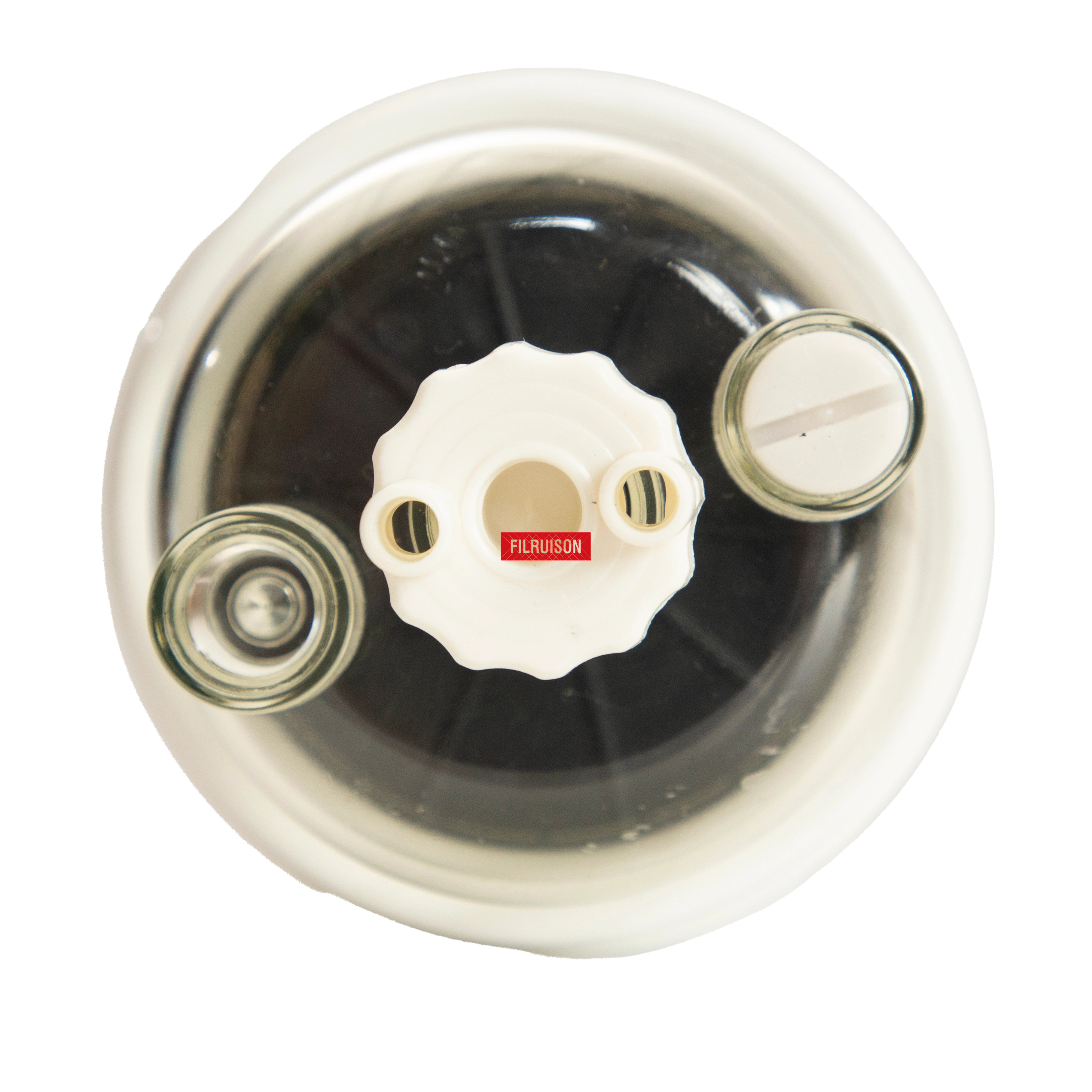
Located at the lowest point of the assembly, the Water Bowl acts as the collection reservoir. Because moisture is denser than diesel, gravity forces separated droplets to settle here.
Clear polycarbonate bowls allow operators to visually inspect fluid levels during morning walk-arounds. However, they are susceptible to melting near exhaust manifolds and can shatter upon impact with kicked-up field debris. In high-heat or exposed areas, cast metal bowls are required by safety standards. You must measure the physical drop-down clearance on your frame to ensure a technician can comfortably reach the drain petcock.
The inlet and outlet ports must integrate seamlessly with your existing lines. Standard agricultural sizes include quarter-inch, three-eighths, and half-inch National Pipe Thread. It is an engineering best practice to match the port size directly to the inner diameter of the hoses. Forcing a large hose into a restrictive adapter fitting creates a sudden fluid bottleneck. This induces turbulence and negates the benefits of a high-capacity unit.
The agricultural sector primarily utilizes two distinct technological approaches to extract moisture. The choice depends heavily on your operating environment and fuel quality.
Media-based coalescing separators rely on chemically treated, hydrophobic paper or synthetic nano-fibers to actively repel moisture. As fluid passes through, microscopic droplets bead up on the surface, merge into larger drops, and fall into the bowl. They are highly compact, cost-effective, and incredibly easy to maintain via quick spin-on replacements. However, a massive sudden slug of water can eventually overwhelm the hydrophobic coating.
Centrifugal separators utilize a physical multi-stage process. These units force fluid through internal vanes to initiate a high-speed rotational vortex. Centrifugal force throws heavy moisture and solid particulates against the outer walls. The contaminants drop into the reservoir before the fluid even touches the filter paper. They handle massive volumes of contamination and extend media life significantly. However, they require a bulkier mounting footprint and strict adherence to flow rate sizing.
Looking at the broader agricultural landscape, the shift toward Ultra-Low Sulfur Diesel and higher biodiesel blends has fundamentally changed fuel chemistry. Biodiesel is naturally hygroscopic. This means it actively attracts and holds suspended moisture from the atmosphere much faster than traditional diesel.
Consequently, the industry is seeing a rapid transition away from basic cellulose paper filters. Engineers are moving toward advanced synthetic coalescing media capable of stripping emulsified water from complex fuel blends. Furthermore, precision farming demands zero unplanned downtime. There is a growing trend of integrating electronic Water-In-Fuel sensors directly into the tractor controller area network bus system. These sensors alert the operator via the dashboard exactly when the reservoir needs draining, effectively removing the guesswork from daily maintenance.
To eliminate guesswork and ensure strict mechanical compatibility, follow this objective engineering checklist when specifying a new Diesel Fuel Water Separator for Tractors.
Proper installation and rigorous maintenance routines are just as critical as selecting the correct hardware. Mount the assembly on the suction side of the system. Keep it well away from direct exhaust heat and excessive vibration. Always use high-quality diesel-rated hoses. Secure fittings with appropriate thread sealant to prevent microscopic air leaks, which often cause hard starting.
For maintenance, make it a habit to visually inspect the clear collection reservoir every morning before the dew burns off. Open the petcock valve and drain it the moment a visible water line accumulates. Never allow the fluid level to reach the bottom of the filter media. Finally, replace the cartridge based on the manufacturer recommended service intervals. This is typically every 250 to 500 hours. Replace it immediately if you notice a sluggish throttle response indicating a restriction.
Choosing the right filtration hardware is not a matter of guesswork. It is a calculated upgrade that protects the heart of your machinery. By accurately calculating the required capacity, selecting the appropriate micron staging, and ensuring physical component compatibility, you safeguard your engine against the devastating effects of moisture and particulate contamination.
This relatively small upfront investment prevents catastrophic injection system failures. It saves thousands of dollars in emergency rebuilds and prevents crippling downtime during your busiest seasons. Take the time to review your engine specifications today. Apply the formulas provided in this guide, and upgrade your equipment with a perfectly sized conditioning unit. For operators demanding uncompromising reliability, browse the high-performance filtration solutions at Sykingtech to find the exact match for your agricultural machinery.
Yes, but with specific caveats. Marine units are exceptionally robust and highly efficient. They often feature metal heat shields and fire-resistant components required by maritime law. However, you must ensure the flow capacity and port sizes strictly match your agricultural equipment. Marine units are often designed for massive high-displacement boat engines. Installing one on a compact utility tractor will likely result in severe oversizing, which kills the efficiency of centrifugal models.
An undersized unit acts as a severe bottleneck. The lift pump must work overtime to pull fluid through dense media. This can prematurely burn out the pump motor. More noticeably, your engine will experience fuel starvation. You will feel the tractor lose power under heavy draft loads, experience fluctuating engine speeds, and potentially stall out entirely in the middle of a field.
Industry best practice dictates a visual inspection every single day before you turn the key. You should open the drain valve whenever a distinct line of moisture accumulates at the bottom. The golden rule is to drain it long before the water level rises high enough to touch the paper filter element. Soaking the media will ruin its hydrophobic properties.
The choice depends on the unit location in your fluid architecture. If you are installing it as a pre-filter located near the tank before the factory filter, use a 30-micron element. This catches bulk debris and moisture without restricting flow. If you are completely replacing the main factory filter, use a 10-micron element, or strictly adhere to the specific micron rating dictated by your tractor manufacturer.
If you operate your machinery in freezing winter conditions, such as plowing snow or feeding livestock on sub-zero mornings, an integrated 12-volt heater is a highly recommended investment. It prevents the paraffin wax naturally present in diesel from crystallizing. Gelled fuel will permanently clog the microscopic pores of the filter media during cold starts.
A failing separator usually presents distinct drivability issues. You will notice a sluggish throttle response, a lack of power when pulling heavy implements, or the engine sputtering under load. Visually, if the clear bowl is cloudy, filled with dark sludge, or if you see water bypassing the filter element and traveling up the fuel line, the internal media has been compromised and requires immediate replacement.
No, you should never attempt to clean and reuse a spin-on or cartridge-style filter element. The microscopic pores in the synthetic or cellulose media trap debris deep within their structure. Using compressed air or solvents will tear the delicate fibers, destroying its filtration capability and allowing abrasive dirt and water to flow directly into your high-pressure injectors. Always replace the element with a new one.
