
Views: 0 Author: Site Editor Publish Time: 2026-08-05 Origin: Site


Engine dusting destroys equipment in high-particulate environments like mining, agriculture, and construction. When microscopic silica dust bypasses the primary filtration system, it acts as an abrasive paste inside the cylinders. This causes rapid piston ring wear, loss of compression, and catastrophic engine failure. Relying solely on primary pleated air filters under heavy dust loads leads to rapid restriction increases, parasitic power loss, and frequent maintenance intervals. Pre-filtration at the intake stage solves this problem directly. The Static Vane Air Precleaner is a high-reliability, zero-moving-parts solution designed to intercept bulk debris before it reaches the primary filtration system. By manipulating fluid dynamics, these devices extend filter life and protect engines from premature wear.
To evaluate precleaner efficacy, engineers must understand how fixed geometry manipulates fluid dynamics to isolate particulate matter. The design relies entirely on the shape and orientation of stationary components to separate dust from the air stream. Field data shows that understanding these mechanics allows maintenance teams to better diagnose intake issues and optimize equipment performance in severe environments.
Incoming linear airflow strikes the angled, stationary louvers, commonly known as vanes. These vanes convert the linear velocity of the air into rotational velocity, creating a cyclone or vortex inside the housing. The relationship between vane pitch, boundary layer attachment, and airflow speed determines the centrifugal force applied to suspended particles. A well-designed static vane air precleaner maximizes this rotational energy to ensure effective separation. The angle of the vanes is engineered to create maximum swirl with minimum pressure drop. When air enters the housing, it is forced to change direction rapidly. This sudden change in vector initiates the vortex. The boundary layer of the air stream must remain attached to the vane surface to prevent turbulence, which would otherwise disrupt the centrifugal action and allow dust to bypass the separation zone.
As the air spins, the mass of dust, dirt, and moisture causes them to be thrown outward against the inner housing wall of the separator. This relies on the physics of particle mass versus aerodynamic drag in a rotational flow. Heavier particles possess greater inertia, allowing them to overcome the drag of the air stream and migrate to the perimeter. Silica dust, common in mining and earthmoving, has a high specific gravity. This makes it particularly susceptible to centrifugal separation. The outer wall of the precleaner acts as a containment boundary, guiding the heavy particulate down toward the scavenge area while the lighter, clean air remains in the center of the vortex. The efficiency of this process depends heavily on maintaining a high rotational velocity; if the air slows down, the aerodynamic drag overcomes the centrifugal force, and the dust remains suspended in the air stream.
Once separated, the particulate is channeled away from the clean air stream. The scavenge chamber collects this debris, which is then expelled through ejection ports. Systems typically use either gravity drop tubes or exhaust-aspirated scavenge systems to remove the accumulated material, preventing it from re-entering the intake flow. Gravity systems rely on a one-way rubber valve, often called a duckbill valve, which opens under the weight of the accumulated dust and the pulsing vacuum of the engine. Exhaust-aspirated systems are more complex but highly effective. They route a hose from the precleaner's scavenge port to a venturi installed in the vehicle's exhaust stack. The flow of exhaust gases creates a continuous vacuum, actively pulling the dust out of the precleaner and ejecting it out the tailpipe. This active scavenging prevents dust buildup in the chamber, which is a common cause of precleaner failure in extreme dust conditions.
A central clean air tube, often called the vortex finder, draws the lighter, purified air from the center of the cyclone. It directs this cleaner air into the engine intake system with minimal flow resistance. This ensures that the primary filter receives air that is largely free of bulk contaminants. The vortex finder is positioned precisely to avoid drawing in the turbulent, dust-laden air near the outer walls. Its diameter and depth within the housing are calibrated to match the specific CFM rating of the precleaner. If the vortex finder is too large, it will ingest dust; if it is too small, it will create excessive restriction, starving the engine of air. The smooth transition from the swirling vortex to the linear flow of the intake pipe is necessary to maintain volumetric efficiency and engine performance.
Comparing static systems against dynamic, rotor-driven precleaners establishes baseline use cases for different operating environments. Equipment managers must weigh the benefits of zero moving parts against the active separation provided by spinning rotors.
Static vanes offer superior durability in high-vibration environments compared to dynamic precleaners that rely on bearings and spinning rotors. Dynamic systems carry the risk of rotor stalling or bearing seizure in highly abrasive dust conditions. Off-design airspeeds in dynamic systems can cause aerodynamic blade stall or flow separation. A fixed vane dust separator maintains mechanical integrity at all flow rates because it lacks moving parts. In a rock quarry, the constant shock and vibration from blasting and loading operations quickly destroy the bearings in dynamic precleaners. Once the bearing fails, the rotor stops spinning, and the device becomes a major restriction in the intake system, offering zero separation. Static systems, being a single cast or molded piece, are immune to this type of mechanical failure. They continue to separate dust as long as there is airflow, making them the standard for heavy earthmoving equipment.
Engineers evaluate the initial restriction introduced by static vanes versus the energy required to spool up a dynamic rotor. Static systems maintain consistent restriction profiles over time. Failing dynamic systems can choke the engine intake if the rotor seizes or slows down, leading to significant performance degradation. Every component added to an intake system creates some level of restriction, measured in inches of water (inH2O). Static precleaners typically introduce a fixed restriction that scales predictably with airflow. Dynamic precleaners, however, require energy from the incoming air to spin the rotor. This creates a parasitic load that can delay turbocharger spool-up and reduce throttle response.
| Feature | Static Vane Precleaner | Dynamic Rotor Precleaner |
|---|---|---|
| Moving Parts | None | Bearings, Rotor Blades |
| Vibration Tolerance | Excellent | Poor to Moderate |
| Maintenance Requirement | Low (Inspect scavenge lines) | High (Bearing replacement, rotor cleaning) |
| Restriction Profile | Consistent, predictable | Variable, spikes upon bearing failure |
| Ideal Environment | Mining, heavy construction, agriculture | Light industrial, on-highway |
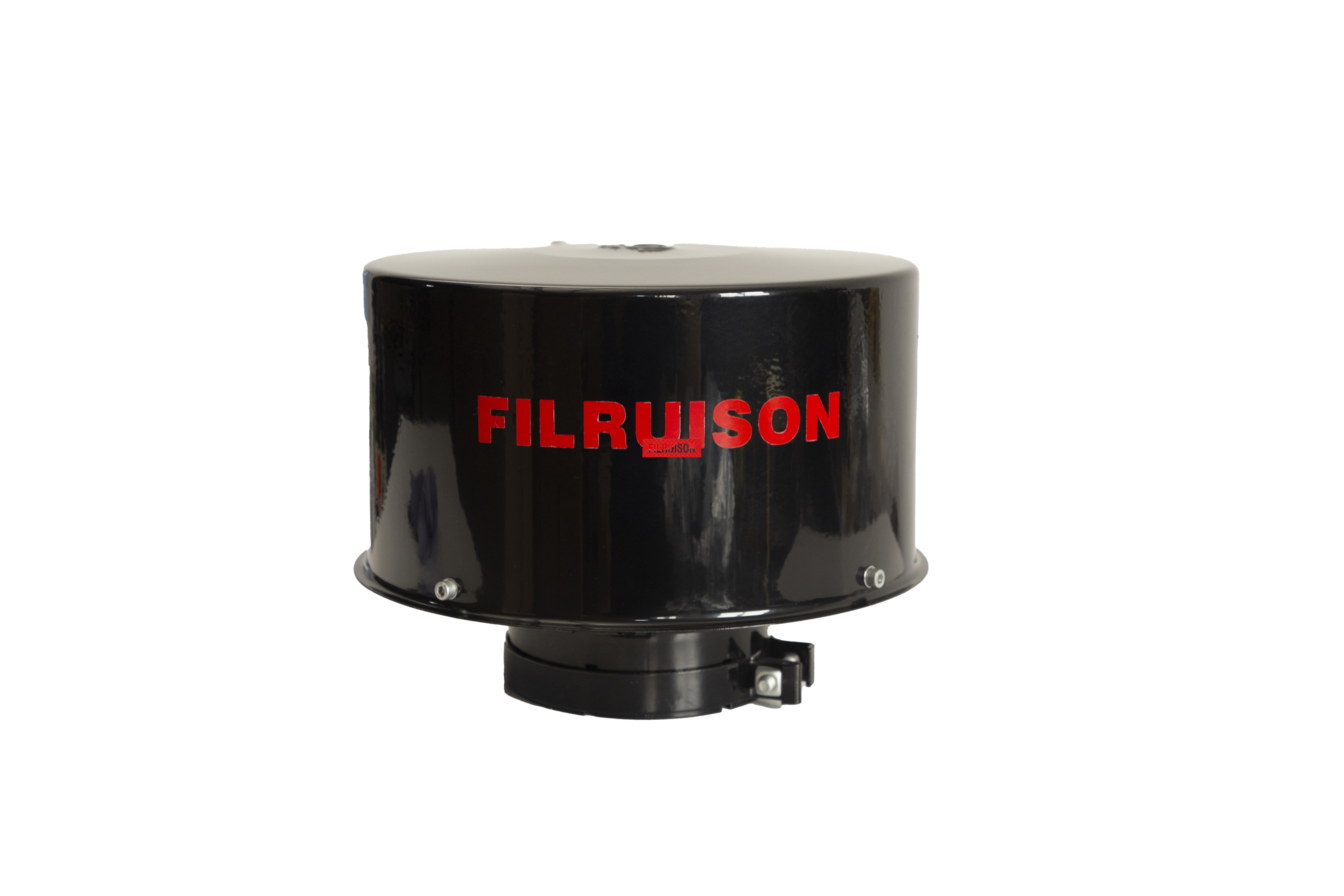
Selecting the correct unit requires a framework based on engine specifications and the operating environment. Guesswork in sizing leads to poor performance and potential engine damage.
Sizing is critical. Oversized units fail to generate sufficient vortex velocity, resulting in poor separation. Undersized units cause severe intake restriction. Calculating the required engine CFM involves multiplying Engine Displacement by RPM and Volumetric Efficiency. This ensures the engine breathes with as little resistance as possible while maintaining optimal separation efficiency. For a four-stroke diesel engine, the formula is: CFM = (Engine Displacement in cubic inches x Maximum RPM) / 3456 x Volumetric Efficiency. Most turbocharged diesel engines have a volumetric efficiency between 1.5 and 2.0, depending on boost pressure.
If a machine operates primarily at part-throttle, size the precleaner for the average operating RPM rather than the absolute maximum, ensuring the vortex remains strong during normal work cycles.
Realistic efficiency claims are important. Static vanes perform exceptionally well on heavy, coarse dust larger than 10 microns. They rely on the primary filter to capture fine soot and sub-micron particles. An engine intake static precleaner is a pre-filtration device, not a complete replacement for fine filtration media. In agricultural settings, chaff and large dirt clods are easily separated, often achieving 95% efficiency by mass. However, in environments with high concentrations of fine talc or coal dust, the efficiency may drop to 70-80%. The primary pleated filter remains the final barrier, capturing the 2-5 micron particles that cause the most severe engine wear. Understanding this relationship prevents unrealistic expectations and ensures maintenance schedules are adjusted accordingly.
Gravity-driven dust ejection valves offer simplicity. Exhaust-aspirated systems use exhaust gas velocity to pull a vacuum on the precleaner scavenge line, providing continuous self-cleaning performance. The choice involves trade-offs in installation complexity versus the efficiency of debris removal under varying conditions. Gravity valves require vertical mounting and are susceptible to clogging if wet material enters the housing. They must be inspected daily. Exhaust-aspirated systems require routing steel tubing from the intake to the exhaust stack, welding a venturi into the exhaust, and ensuring all connections are airtight. While installation is labor-intensive, the result is a system that actively pulls dust away regardless of orientation or moisture content, making it the preferred choice for heavy mining equipment.
Addressing the practical challenges of retrofitting or specifying static precleaners ensures successful deployment and prevents unexpected downtime.
Spatial constraints, hood clearance, and the necessity of weather hoods or rain caps must be considered. Mounting orientation is also crucial; gravity ejectors must point downward. An Alternate Air Intake System or bypass air valve is necessary to provide uninterrupted airflow if the primary intake or static precleaner experiences catastrophic environmental blockage, such as wet snow packing, icing, or heavy leaf blinding. When retrofitting a machine, mechanics must ensure the intake piping can support the weight of the precleaner, especially under heavy vibration. Reinforcement brackets are often required. Furthermore, the precleaner must be positioned away from exhaust heat and direct water spray. If the machine operates in winter conditions, snow can pack into the vanes, completely choking the engine. A spring-loaded bypass valve installed downstream of the precleaner will automatically open under high vacuum, allowing the engine to draw air from under the hood until the blockage is cleared.
The primary failure mode of static systems involves blocked scavenge lines or stuck ejection valves. The sticky vane phenomenon occurs when crankcase ventilation oil vapors or exhaust soot blowback migrate to the intake, coating the static vanes with an adhesive film. This film traps dust directly on the vanes, ruins the engineered aerodynamic profile, and requires regular solvent cleaning to prevent severe intake restriction.
Ignoring these maintenance steps negates the benefits of the precleaner. A blocked scavenge line turns the precleaner into a dust trap, eventually dumping a massive load of dirt directly into the primary filter all at once.
Static vanes experience reduced centrifugal separation efficiency during idle or low-RPM operations. As airflow velocity drops, the vortex G-forces decrease, allowing more dust to bypass the precleaner and reach the primary filter. This is an inherent limitation of fixed geometry designs operating at off-design speeds. For equipment that idles extensively in dusty environments, such as loaders waiting at a crusher, the primary filter will load faster than it would during full-throttle operation. Operators should be trained to understand that precleaners work best when the engine is working hard. Adjusting operational habits to minimize idling in dust clouds extends filter life significantly.
A static vane air precleaner provides a reliable, cost-effective method for protecting heavy-duty engines in high-dust environments, provided it is sized correctly. The decision to implement one hinges on accurate CFM matching, the choice between gravity or aspirated scavenging, and the physical mounting constraints of the equipment.
A: A static vane uses fixed geometry to swirl incoming air, creating a vortex without moving parts. A dynamic precleaner relies on moving rotors and bearings driven by airflow to physically separate dust from the air stream.
A: They typically remove 75% to 95% of airborne mass. Efficiency depends heavily on particle size, with coarse, heavy dust separating much easier than fine, sub-micron particulate.
A: It introduces a slight initial pressure drop. However, this is offset by preventing the primary filter from clogging rapidly, which maintains overall airflow and engine performance over a longer period.
A: If equipped, an alternate air intake or bypass system opens automatically under high vacuum to pull auxiliary engine air from under the hood, preventing the engine from stalling.
A: Yes. Oil vapors coat the static vanes, causing dust to adhere. This ruins the vortex aerodynamics and restricts airflow, requiring periodic solvent washing to restore function.
A: No. Precleaners only remove bulk and heavy debris. A primary pleated filter remains mandatory for capturing the fine particulate that causes severe engine wear.
A: Low air velocity fails to create a strong enough vortex. The centrifugal force is too weak, allowing dust to bypass the scavenge system and reach the primary filter.
