
Views: 0 Author: Site Editor Publish Time: 2026-10-18 Origin: Site


Modern machinery design faces a persistent architectural squeeze. Industrial equipment and commercial vehicles are becoming increasingly advanced. Consequently, the physical real estate available for life-support components continues to shrink. Engines, blowers, and compressors require massive volumes of clean air to maintain optimal combustion. However, traditional bulky flat-panel filter boxes simply cannot fit into these awkward areas. They force engineers to severely sacrifice crucial filtration capacity.
To navigate this dilemma, field mechanics and designers turn to the Cylindrical Air Filter. By abandoning the linear two-dimensional plane for a continuous circular geometry, this component delivers maximum purification within a minimal footprint. High-performance machinery gets the uninterrupted airflow it demands without requiring obstructive housing units.
Industry shifts heavily influence this design choice. The relentless push for electrification, hybrid powertrains, and strict modern emission standards requires massive exhaust aftertreatment modules. Manufacturers are cramming battery cooling arrays and complex wiring harnesses into existing chassis designs. As a result, the physical space allocated for traditional intake systems has plummeted by nearly a third in newer models. This spatial deficit demands filtration solutions capable of handling massive cubic feet per minute requirements without occupying sprawling footprints.
At its core, a cylindrical air filtration unit is a highly engineered device designed to strip abrasive dust and debris from the air. Flat panels process air in a straight line. In contrast, tubular models operate by pulling air from the outside in through a densely packed circular array of media.
The structural anatomy is built for absolute endurance. The delicate filter media is sandwiched between an inner and outer protective metal mesh. This rigid framework prevents the cylinder from collapsing under intense vacuum suction. Furthermore, the ends feature durable polyurethane bases equipped with precision elastomer seals. This construction creates a completely airtight environment.
In fluid dynamics, radial design highlights the specific way incoming air interacts with the component. It distributes the incoming air pressure evenly across the entire 360-degree circumference. By preventing localized high-pressure zones, the filter avoids premature media tearing. It ensures a uniform accumulation of dust, which drastically extends the operational lifespan of the unit.
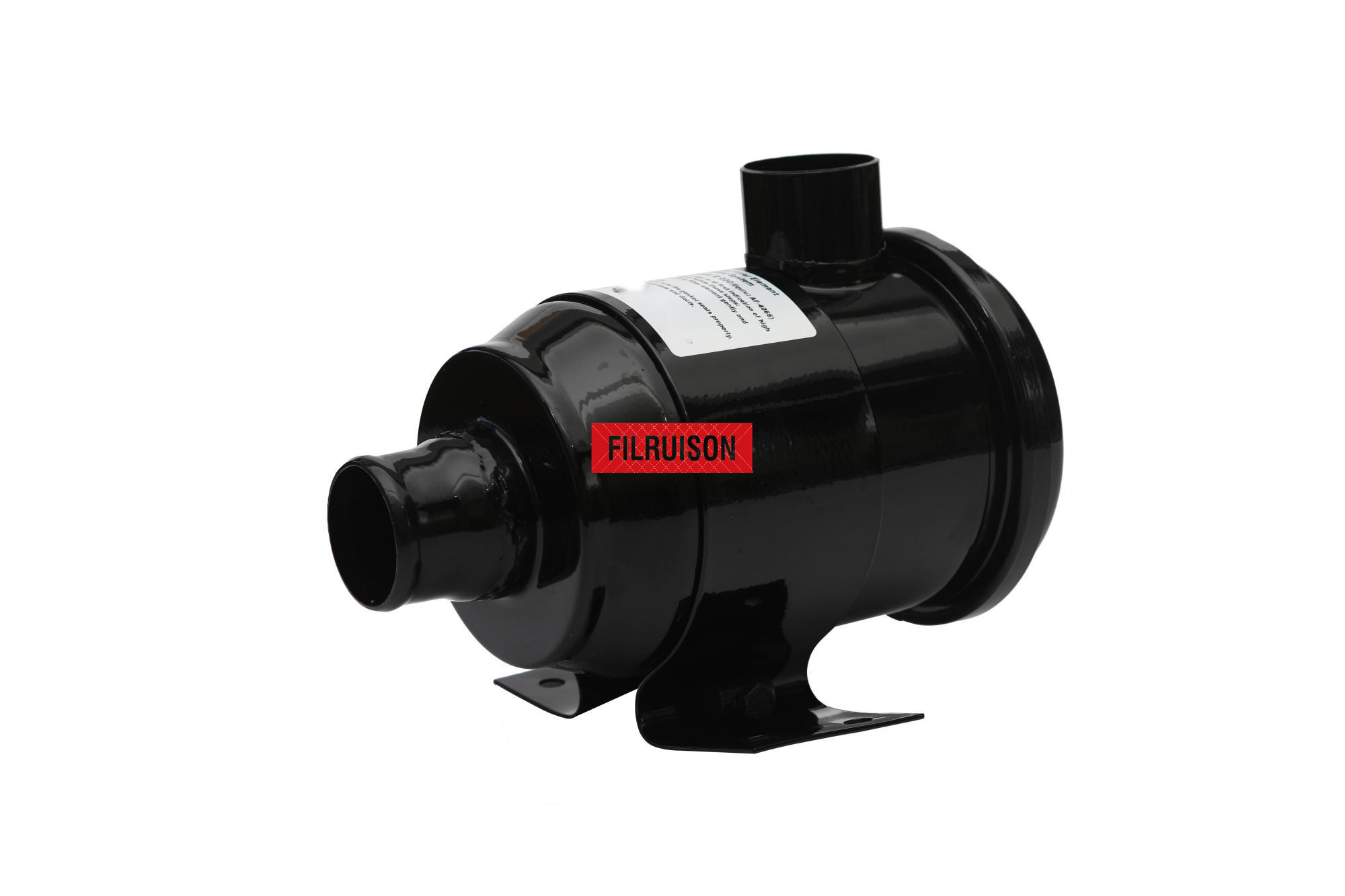
The fundamental superiority of a tubular filter in confined spaces comes down to pure geometry. Filtration capacity is directly proportional to the available surface area of the media. More surface area translates to lower air resistance and a vastly higher capacity for trapping dirt. By folding and wrapping the media into a continuous circle, engineers pack an astonishing amount of active filtration surface into a surprisingly small volumetric space.
When installed inside a Compact Housing, a cylindrical unit offers two to three times the dirt-holding capacity of a flat panel occupying the exact same width. Absolutely no space is wasted on thick plastic borders or structural frames that typically surround standard flat filters.
| Feature | Flat Panel Filter | Cylindrical Filter |
|---|---|---|
| Airflow Intake | Unidirectional | 360-Degree Omnidirectional |
| Space Utilization | Poor in deep cavities | Excellent in awkward voids |
| Surface Area to Volume | Low | Extremely High |
| Sealing Reliability | Moderate | High via axial/radial compression |
Severe space constraints actively disrupt and choke airflow dynamics. Intake paths are rarely straight in restricted environments. Incoming air must navigate through narrow or angled channels. If a flat directional filter is placed in such an environment, air strikes only one small section of the media. This leads to rapid localized clogging and engine suffocation.
A Radial Filter effortlessly overcomes this physical limitation. Its omnidirectional intake means that even if one side is shoved flush against the wall of a tight Engine Bay, the remaining exposed sides still breathe freely. The air naturally flows around the curvature of the cylinder to find the path of least resistance.
High pressure drop forces a compressor to work exponentially harder just to breathe. This directly cannibalizes fuel efficiency and mechanical horsepower. By distributing the incoming air over a vast surface area, the velocity of the air passing through any single microscopic pore is drastically lowered. This results in smoother airflow, preserving the thermodynamic efficiency of the equipment.
Maximizing surface area is vital. Yet, the entire system is rendered useless if unfiltered air bypasses the media. Installing components in tight spaces presents a massive mechanical hurdle. Imagine reaching blindly into a poorly lit enclosure. You cannot easily see the seating groove or perfectly align the housing lid. This blind installation significantly increases the risk of a pinched gasket and catastrophic dust ingestion.
To neutralize this risk, the industry relies heavily on the Axial Seal Filter mechanism. Axial sealing utilizes the vertical compressive force of the housing lid pressing down directly onto the filter's resilient polyurethane end cap.
Specifically, premium industrial products like the Sykingtech KL2 axial air filter utilize high-grade polyurethane elastomer caps. These advanced materials maintain a compression set of less than fifteen percent even under extreme temperature fluctuations. When the lid is clamped shut, it crushes the pliable cap against the base of the housing. This creates a foolproof gasket seal that automatically compensates for minor installation misalignments.
Selecting the correct purification component for a confined application requires a meticulous evaluation of equipment specifications. A highly efficient filter only performs if it perfectly matches the aerodynamic requirements of the machinery.
The cylindrical air filter stands as the definitive engineering solution for machinery plagued by severe space constraints. By leveraging a continuous circular geometry, it delivers unmatched surface area and omnidirectional airflow. Engines and compressors breathe easily even in the most cramped compartments. Furthermore, advanced axial sealing designs remove the guesswork from blind installations.
Compromising on physical space should never mean sacrificing operational lifespan. Evaluate your current compact machinery today to identify potential intake bottlenecks. To find the exact fit for your heavy-duty applications, explore the high-performance solutions at Sykingtech. Upgrade your intake systems with precision-engineered filters before critical mechanical failures occur.
Heavy-duty vehicles operate in environments with extreme dust levels. Cylindrical designs offer a significantly larger surface area within the same volumetric space. This allows them to hold massive amounts of dirt without restricting airflow, extending maintenance intervals far beyond what a flat panel could achieve.
A high pressure drop acts like a restricted airway for an engine. It forces the turbocharger or cylinders to work harder to pull in necessary air. This reduces overall horsepower, increases fuel consumption, and raises exhaust gas temperatures. Efficient tubular filters minimize this drop by distributing air intake across a wider 360-degree surface.
Generally, you cannot simply swap them. You must install an aftermarket cold air intake system or utilize a specific compact housing designed to convert the intake. Machinery is factory-calibrated for one specific filter shape and volume.
Replacement intervals depend heavily on the operating environment. Because they hold significantly more dirt, they often last much longer than standard flat panels. In heavy dust environments like construction sites, they should be inspected regularly and replaced according to engine operating hours.
An axial seal filter creates an airtight barrier by compressing the ends of the filter against the housing using top-to-bottom vertical pressure from the lid. In contrast, a radial seal filter seals along the inner or outer diameter of the filter neck using side-to-side lateral pressure against a fixed intake tube.
Certain aftermarket filters made of oiled cotton gauze are washable. However, standard heavy-duty industrial filters are constructed from tightly woven cellulose paper. These paper-based filters cannot be washed and must be completely replaced once they reach their dust-holding capacity.
