
Views: 0 Author: Site Editor Publish Time: 2026-09-24 Origin: Site


Quick Answer: Increasing a filter’s surface area through deep pleating directly enhances its dust holding capacity, which extends its service life and reduces maintenance downtime in heavy industrial environments. By maximizing the amount of filtration media exposed to the airstream, high-capacity filters lower air velocity and delay the terminal pressure drop that forces a replacement. This article explains the physics of deep pleat filtration, the engineering behind compact industrial filter designs, and how pre-separation technology further protects heavy machinery.
Key Takeaways:
The fundamental mechanism that determines how long an air filter can operate before requiring replacement is its dust holding capacity. Dust holding capacity is the total weight of particulate matter a filter can trap and retain before the accumulation restricts airflow to an unacceptable level, known as terminal pressure drop. The primary variable that dictates this capacity is the total surface area of the filtration media exposed to the incoming airstream.
To understand this concept, consider a common commercial scenario: just as a standard 16 x 20 x 5 air filter utilizes its five-inch depth to increase surface area during a routine HVAC filter replacement, industrial filtration applies this exact same geometric principle on a much larger, heavy-duty scale. While a pleated 16x20x5 filter provides significantly more media than a flat one-inch alternative, heavy machinery requires an exponential increase in that surface area to survive harsh operating environments.
This is achieved through the use of a deep pleat filter design. By folding the filtration media into dense, deep V-shapes, engineers can exponentially increase the square footage of the media without expanding the outer dimensions of the filter frame. This increased surface area serves two critical physical functions. First, it provides more physical space for particulates to accumulate, directly increasing the dust holding capacity. Second, it significantly lowers the face velocity—the speed at which air travels through any given square inch of the media.
When air velocity is reduced, the filtration media captures particles more effectively through mechanisms like interception, diffusion, and inertial impaction, while simultaneously reducing the aerodynamic drag that causes pressure drop. As particulates build up on the media, they form a dust cake that naturally restricts airflow. A filter with a small surface area will experience a rapid spike in differential pressure as this cake forms, forcing an immediate shutdown and replacement. Conversely, a high capacity filter distributes that same volume of dust across a massive surface area, allowing the system to maintain optimal airflow and acceptable pressure levels for a significantly longer duration. This prevents the system's fans or engines from working harder to pull air through restricted media, thereby saving energy and reducing thermal stress.
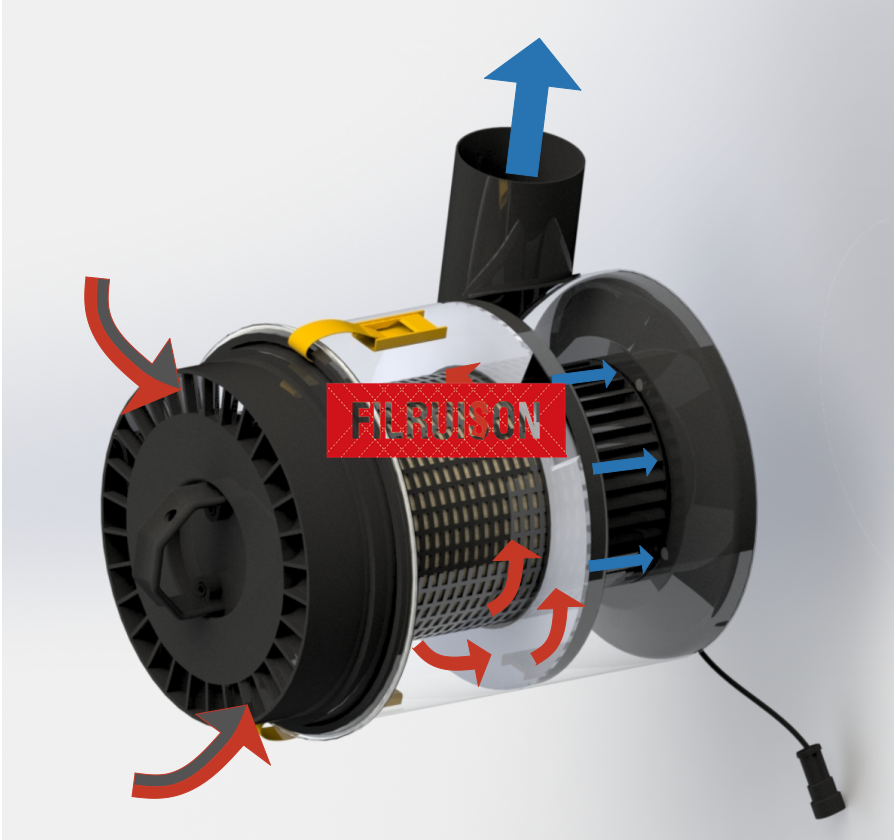
While the physics of surface area clearly dictate that more media equals a longer lifespan, applying this principle to industrial equipment presents a severe engineering challenge. Heavy machinery, such as mining excavators, industrial air compressors, and off-road construction vehicles, operates with strict spatial constraints. Engine compartments and equipment housings rarely have the physical room to accommodate massive, oversized filter housings. The engineering objective is therefore to maximize the internal surface area of the filter while minimizing its external footprint.
Achieving this requires advanced pleating technology and structural integrity that prevents the dense media folds from collapsing under high airflow and heavy dust loads. If pleats collapse and pinch together—a phenomenon known as pleat bunching—the effective surface area is instantly reduced, negating the benefits of the deep pleat design. Shanghai SYKING Industry Technical co.,Ltd. has 45 years of experience in filtration products, starting in 1975, focusing specifically on solving these spatial and environmental challenges for engines and air compressors.
A primary example of overcoming this spatial limitation is the DCF Series Air Filter. Through optimized pleat geometry and advanced media stabilization, the DCF Series provides a 50% greater filter surface element while requiring 40% less installation space. By shrinking the required housing volume, equipment manufacturers can integrate highly efficient filtration into tighter engine compartments without sacrificing dust holding capacity. The 50% increase in surface area directly translates to a longer operational period before the terminal pressure drop is reached, reducing the frequency of maintenance interventions in the field.
Important limitation:
By utilizing these compact, high-capacity designs, procurement managers and maintenance teams can extend the service intervals of their heavy machinery. Fewer filter changes mean less planned downtime, reduced labor costs, and a lower risk of engine or compressor starvation caused by neglected, heavily restricted filters.
Even with a 50% increase in surface area, a primary high-capacity filter operating in extreme environments—such as open-pit mines, quarries, or heavy construction sites—will eventually face overwhelming particulate loads. Relying solely on the primary filter media to capture all airborne debris, including heavy sand and large dust particles, is inefficient and will prematurely exhaust the filter's dust holding capacity. To truly maximize the service life of the primary filtration system, the incoming air must be pre-cleaned before it ever reaches the pleated media.
This is achieved through two-stage filtration systems that utilize vortex centrifugal pre-dust separation. When heavily contaminated air enters the pre-cleaner, it is forced into a rapid rotational motion. The centrifugal force generated by this vortex causes the heavier particulates to be thrown outward against the walls of the separation chamber, where they lose kinetic energy and are safely expelled from the system. This mechanical separation process requires no replaceable media, operates continuously, and can remove the vast majority of heavy dust mass from the airstream.
Shanghai SYKING integrates this technology into comprehensive environmental controls, such as the Intelligent Cabin Overpressure Air Filtration Unit. This system utilizes vortex centrifugal pre-dust separation combined with multi-layer fine filtration to protect equipment operators in hazardous environments. By stripping the heavy particulate load out of the air first, the multi-layer fine filtration media is preserved, allowing its deep-pleated surface area to focus entirely on capturing microscopic contaminants like PM2.5, pollen, and aerosols.
Furthermore, protecting the internal environment requires precise airflow management. The Intelligent Cabin Overpressure unit features a CCU controller that automatically adjusts the fan speed based on cabin pressure differences between 0-200Pa. By maintaining a constant positive pressure inside the cabin, the system ensures that external, unfiltered dust cannot seep in through door seals or structural gaps. This automated overpressure control not only protects the operator's health but also prevents internal HVAC and secondary filtration systems from being overwhelmed by fugitive dust, thereby extending the lifecycle of all internal climate control components.
A standard flat filter presents a single, two-dimensional plane of media to the airstream, which limits its dust holding capacity and causes rapid pressure drop as particles accumulate. A deep pleat filter folds the media into dense V-shapes, exponentially increasing the total square footage of the filtration surface within the same outer frame dimensions. In industrial use, this geometry lowers the face velocity of the air, improves capture efficiency, and allows the filter to hold a significantly larger volume of dust before requiring replacement.
Heavy machinery, such as industrial air compressors and mining engines, requires massive volumes of clean air to operate efficiently. If a filter has a low dust holding capacity, it will clog quickly in harsh environments, leading to a severe pressure drop. This restriction starves the engine or compressor of air, reducing power output, increasing fuel consumption, and potentially causing catastrophic thermal or mechanical failure. High dust holding capacity ensures the equipment can operate safely between scheduled maintenance intervals.
Yes. Pre-cleaners act as the first line of defense in a two-stage filtration system. By utilizing centrifugal force to separate and expel heavy particulates—such as sand, dirt, and large debris—before they reach the primary filter, the pre-cleaner drastically reduces the total mass of contaminants the pleated media must handle. This preserves the primary filter's surface area for capturing fine particulates, significantly extending its operational lifespan.
Cabin overpressure systems actively pump filtered air into an enclosed operator cabin to create a positive pressure environment relative to the outside atmosphere. This positive pressure ensures that if there are any leaks in the cabin's seals or joints, clean air is pushed out, preventing hazardous external dust and aerosols from seeping in. This protects the operator's respiratory health and prevents internal equipment from being contaminated by fugitive dust.
Understanding the relationship between filter surface area, compact design, and pre-separation technology is critical for optimizing maintenance schedules and protecting heavy industrial equipment. Upgrading to high-capacity filtration systems can reduce downtime and improve overall operational efficiency in harsh environments. To review the specific technical dimensions, airflow capacities, and integration requirements for your machinery, consult the engineering specifications for the DCF Series Air Filter and the Intelligent Cabin Overpressure Air Filtration Unit.
